From knowledge
to learning by doing
Instructional Design | Learning Paths | Automotive | CEE Region
How can existing development paths be redesigned to go beyond knowledge transfer and prepare employees for the situations they face every day?
The project involved redesigning development paths for 7 key roles in the dealer network of a premium brand across Central and Eastern Europe.
The starting point was not a lack of knowledge or training materials. The paths already existed and covered a broad range of content. The challenge was to redesign them so that knowledge was more closely connected with practice and the learning formats were better aligned with what employees needed to learn.

STARTING POINT
The existing paths had been created mainly for remote delivery and were based on online training, e-learning, and coaching sessions.
Feedback from participants and their managers showed that the development process needed to be more closely connected with everyday practice, with more opportunities to practise the skills employees actually need in their work.
Five principles for designing learning paths

Competencies first. Solution second.
I began with a detailed analysis of the existing paths and mapped them against the competency model for each role. I also drew on my experience of working with dealers and consulted representatives from different business areas to verify what employees genuinely needed in their everyday work.

A shared foundation. Different roles.
Separate paths were created for seven roles, with content tailored to each one. This did not mean seven independent programs. Where roles required the same competencies, I retained a common foundation; where their day-to-day work differed, I differentiated the content, exercises, and learning experiences.

The right format for the right goal.
Knowledge suitable for self-study was moved into e-learning and microlearning. Knowledge that needed structure went into short trainer-led online sessions. Knowledge essential for correct job performance was assessed through tests. Competencies requiring application and practice were developed in trainer-led workshops.

At least 70% practice.
The new workshops were designed around one key principle: at least 70% of the time was devoted to practice. Exercises reflected real situations employees encounter every day. Wherever possible, participants worked in the actual systems used in their jobs.

Designing for reality.
I deliberately chose not to use extensive post-training implementation assignments. Experience showed that, under daily operational pressure, employees tend to postpone such tasks or complete them superficially. Practice and verification were therefore built directly into the learning process, where they could be properly supported.
06 What did this look like in practice?
Example: Parts Sales Advisor

Four 90-minute online modules plus an individual development plan. The previous path provided a shared foundation across roles, but was not always closely enough aligned with everyday work or the competencies employees needed to practise.
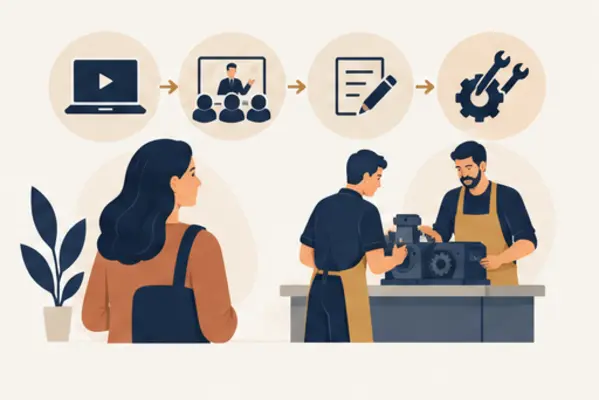
- E-learning courses
- “Knowledge packs” – microlearning
- Preparation task and LMS test
- 90-minute trainer-led online session
- A two-day practical workshop tailored to the role.

Microlearning and e-learning cover processes and system use. The LMS test verifies knowledge of key principles and procedures.
Workshops develop the skills needed to apply processes and work effectively in sales. The path then branches to reflect the nature of the role: in-house sales or field sales.
What actually changed?

From one approach for all employees

To a shared foundation with role-specific learning

From a focus on transferring knowledge

To practising skills in realistic situations

From a single training format

To the right format for each learning goal

From theoretical training content

To real processes, systems, and workplace situations
⭐ The new paths were positively received and became the foundation for further program development across the CEE region.
The goal was not to add more formats to the existing paths.
The goal was to redesign their logic so that knowledge, practice, and verification worked together to prepare employees for what they actually face in their everyday work.